
Lift Each Other Up, LLC


Our Publications


Vaccines Into Arms
With average earnings below $30,000, early care and education workers, like most low-income workers, have a higher risk of serious illness if infected with COVID-19. They are also more likely to be exposed to COVID-19 if they are caring for the children of workers in healthcare and other industries. The state of California has received reports of more than 12,000 cases of COVID in child care settings during the pandemic thus far. While those may not be traceable to child care participation (more traceable to extended family participation, especially where extended family are essential workers) it does indicate that early educators have an elevated risk of either coming into contact with an adult or children who have COVID-19. Thus, vaccination is essential to protect these dedicated human beings from this very serious disease.

The Ripple Effect
Before the pandemic, public and private investment in ECE was already growing our economy in ways that benefited all of us. In 2017, an estimated $13.5 billion industry rippled through California's economy to yield a total of $24.5 billion in economic growth in other sectors, including local and regional businesses. Research shows that every $1 that California invests in early care and education, focused especially on compensation paid to educators, generates almost $2 ($1.88) in economic growth in local and regional economies.

Child Care Keeps Children From Foster Care
During the economic crisis of the last year, children have been at higher risk of homelessness. Especially during the first five years of life - particularly during the first year of life. Homeless children are 34 times more likely to be placed in an out-of-home placement. Access to childcare helps parents attain and sustain the employment that they need to avoid homelessness.

Deep Like the Rivers
In the midst of all the bad news surrounding COVID19, we have good news. For those who want better health outcomes in children, young adults and midlife adults, there is an excellent investment available: quality early care and education (ECE) for low-income children. This investment is highly likely to result in significantly lower health care costs throughout the lifespan.
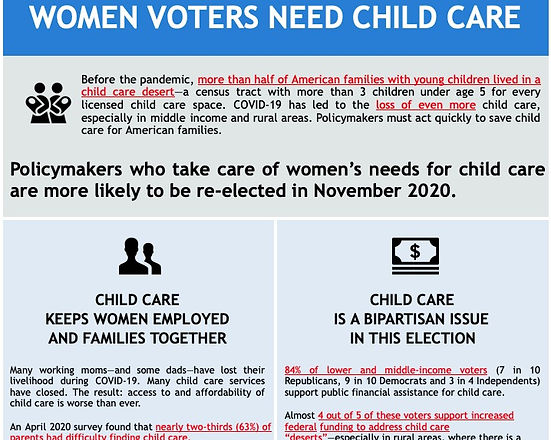
Women Voters Need Child Care
Before the pandemic, more than half of American families with young children lived in a child care desert—a census tract with more than 3 children under age 5 for every licensed child care space. COVID-19 has led to the loss of even more child care, causing women to leave the workforce in large numbers. Policymakers must be aware that women voters will care about their support for public funding for child care when they go to the polls to vote.

The Early Learning Landscape
The Early Learning Landscape in California is in need of two major reforms: much more and better funding; and simplification of administration so that funding streams can be more easily combined. This chapter, part of Stanford’s Getting Down To Facts II, describes in detail the pre-pandemic early learning landscape in California.

What May Be: Financing Early Childhood Mental Health Consultation Services and the Child Care and Development Block Grant
In this article, the authors define ECMHC and discuss opportunities for financing its expansion. They focus on the CCDBG, which at the state level are called the Child Care Development Fund (CCDF) plans. States can elect to use a portion of the CCDBG Quality Set-Aside to help finance ECMHC. State plans for the CCDBG can also be a vehicle for taking stock of the other potential funding streams, such as Medicaid, the Individuals With Disabilities Education Act, Head Start, and state appropriations, to support ECMHC.

Teaching and Leading with Emotional Intelligence
This book provides dilemma-based teaching cases that teachers and early childhood leaders can analyze and discuss to build problem-solving and decision-making skills. Readers will reflect on challenges they are likely to experience in practice, addressing issues such as linguistically and culturally isolated children, children refusing to share with others, high-energy children struggling to develop self-regulation and executive function, and children experiencing trauma. They will also examine issues related to inadequate resources and teacher compensation. Each case portrays early childhood practitioners as they transform challenging scenarios into opportunities for the growth of social and emotional skills.

Lessons from the Life and Work of a Leader
Throughout her life, Gwen Morgan—leader and leadership mentor to hundreds—was a champion of professional development in the field of early childhood care and education. This article presents six lessons that Gwen Morgan’s life can teach us about becoming a leader and about mentoring other leaders.

Does Head Start Help Parents? A Critical Review of Longitudinal Studies of Head Start Children and Families
This paper examined 39 longitudinal studies of Head Start children and families, of which 17 reported parent outcomes. Convergent patterns of parent outcomes as well as the research methods used to investigate those outcomes, were analyzed. Head
Start parents in these studies consistently showed improved abilities to promote their children's educational success. The review strongly suggests that Head Start systematically helps parents achieve positive outcomes and concludes that more research is needed to fully understand the breadth and depth of Head Start's impact on parents.

Parent Empowerment and Child Care Regulation
This article will explore four questions: What do the terms empowerment and disempowerment mean? Do parents need to be empowered? Do early care and education" providers typically empower or disempower parents? Finally, does regulation of early care and education "empower" parents?

Lessons Learned: Provision of Technical Assistance to States. Better Care for the Babies Project.
The Better Care for the Babies (BCTB) Project was initiated in April 1989 to help states improve the quality of infant and toddler child care, especially for low-income children whose parents are in the labor force and/or making the transition from welfare to work. The chapters of this case study describe the background and design of the project, the policy context and assumptions, the technical assistance approach and implementation, project actions and policy improvements related to child care quality made by the BCTB states, the project as perceived by key participating state administrators themselves, lessons learned, and recommendations.

Bridge Over Troubled Waters
This paper discusses the importance of an effective partnership between health services and early childhood programs and examines ways that leaders in both service systems can cooperate to help early educators, health care practitioners and parents achieve good health and early learning outcomes for children. This paper recommends and illustrates possible models of partnership between ECE and childcare; and discusses the historical and contemporary benefits of a strong health focus in early child care programs including the many benefits of such a focus.

Family-Centered Head Start
This paper discusses the importance of the comprehensive, family-centered program known as Head Start and demonstrates the effective ways this program has reduced childhood morbidity and mortality, supported families, and provided a boost to the overall development of children.

Whole Babies, Parents & Pieces of Funds
This article will inform leaders in the early
childhood field about the value of the whole baby approach to child care. It will also
describe the diverse "pieces" of funds which
can be blended together by child care pro-
grams (or in some cases, by child care
resource and referral agencies) to facilitate
the care and education of "whole babies"
instead of fragments of the needs of those
babies.

Parent to Parent - Images of Parents
Originally published by Beacon Press in 1983
We all develop self-images that mirror our judgments of ourselves as effective parents. Many parents undoubtedly view themselves as competent, quiet, rather private individuals who are quite capable of rearing their children with little help from anyone outside their immediate families. Sometimes this self-image may be jarred in moments of crisis or unpleasant encounters with schoolteachers or medical professionals who view parents in a negative light.

Parent to Parent - A History of Parent Activism
Originally published by Beacon Press in 1983
"They are our children, not theirs!" cried angry Jewish parents as they demonstrated in the New York streets in October 1917. These parents were protesting the introduction into the public schools of the Gary Plan, which stressed vocational training over academic preparation. Jewish and other immigrant parents saw the Gary Plan as a way to deny upward mobility to their children. Anti-Gary Leagues were formed by parents in many poor and working-class neighborhoods, and representatives of parent and community groups expressed their opposition at public hearings. One representative said: "There is no parent who is not absolutely opposed to the Gary system. Most of the people of the city believe that it does not fit in with their ideals of education”

Slouching Towards Bethlehem
Originally published by Cambridge University Press in 1983
Writing in The Children's Cause, Gilbert Steiner says, "A children's policy will be successful enough if it concentrates on ways to compensate demonstrably unlucky children whose bodies or minds are sick or whose families are unstable or in poverty" (1976, p. 255). Reasonable people disagree whether the population outlined by Steiner should be the only one of concern to federal policy.

The State of the Child in Appalachia
This report of a 13-state conference on the needs of
young children in the Appalachian region examines present conditions
and changes over the past decade. The conference was organized around
three central guestions: (1) what are the needs of Appalachian
childran for healthy development? (2) how do existing child
dcvelopment programs meet these needs? and (3) what do Appalachian
programs need in order to improve their delivery of services?